
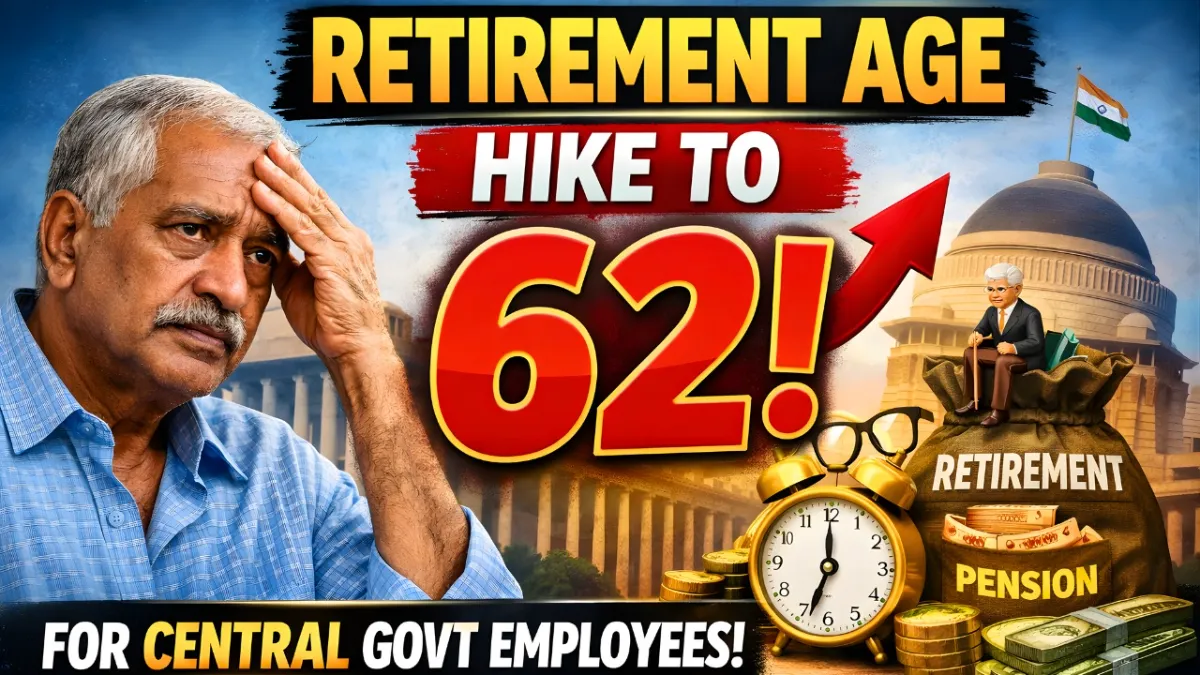
Retirement Age Hike The discussion around a possible retirement age hike to 62 years for Central Government employees has gained momentum in 2026. With increasing life expectancy, improved health standards, and a growing demand for experienced manpower in government departments, the proposal is being seen as a major administrative reform. If implemented, this decision could significantly impact lakhs of serving and future employees, as well as pension rules and workforce planning.
Why the Government Is Considering Retirement Age Increase
At present, most Central Government employees retire at the age of 60 years. However, several expert committees and policy discussions suggest that experienced employees can continue contributing productively beyond this age. Rising longevity, better healthcare facilities, and the need to reduce pressure on pension expenditure are key reasons behind this consideration.
The government also faces shortages of skilled and experienced officers in technical, administrative, and policy-making roles. Increasing the retirement age to 62 would help retain institutional knowledge and reduce frequent recruitment gaps.
Who Will Benefit from the Retirement Age Hike
If the retirement age is officially raised to 62, the immediate beneficiaries will be existing Central Government employees who are nearing retirement. These employees will get two additional years of service, resulting in higher salary earnings, increased pension amounts, and improved retirement benefits.

Departments that rely heavily on expertise, such as finance, railways, defence civilian services, health, education, and scientific research, are expected to benefit the most from this extended service period.
Impact on Salary, Pension, and Gratuity
One of the biggest impacts of the retirement age hike will be on pension calculations. Since pension is based on the last drawn salary and total years of service, an additional two years of service will naturally increase pension payouts. Gratuity amounts are also expected to rise due to longer service duration.
Employees will continue receiving annual increments and allowances during the extended service period, which further strengthens their financial position post-retirement.

New Service Rules Likely to Be Introduced
If the retirement age is increased to 62, the government is expected to revise several service rules. Promotion timelines may be adjusted to avoid stagnation at senior levels. Performance reviews could become stricter to ensure productivity during the extended service period.
The government may also introduce fitness and efficiency standards for employees crossing 60 years, ensuring that only capable and willing employees continue in service.
Concerns About Youth Employment
One of the major concerns surrounding the retirement age hike is its possible impact on youth employment. Critics argue that delaying retirement could slow down fresh recruitment, affecting job opportunities for younger candidates preparing for government exams.

However, experts believe that natural attrition, departmental expansion, and contract-based hiring models will continue to generate employment opportunities, balancing the impact of extended service tenure.
Comparison with Other Sectors
Several state governments and public sector undertakings have already increased or are considering increasing the retirement age. In the private sector, many professionals work well beyond 60 based on performance and expertise. This comparison strengthens the argument that age should not be the only criterion for retirement.
Globally, many developed countries have retirement ages of 62 to 65, reflecting changing demographic and economic realities.

Current Status of the Proposal in 2026
As of 2026, there is no official notification confirming the retirement age hike to 62. The matter is under discussion at policy and administrative levels. Any final decision will require Cabinet approval and formal amendments to existing service rules.
Employees are advised to rely only on official government notifications and not on rumors or unofficial claims circulating on social media.
What Central Government Employees Should Do Now
Employees nearing retirement should stay updated with official announcements and continue their service planning as per existing rules. Financial planning should not be altered until a formal decision is declared. Once approved, the government will provide clear guidelines on implementation, eligibility, and transitional arrangements.

Conclusion
The proposal to increase the retirement age to 62 for Central Government employees is a potentially transformative step. It promises financial benefits for employees, administrative stability for departments, and better utilization of experienced human resources. At the same time, careful policy balancing will be required to protect youth employment and ensure productivity. Until an official announcement is made, the proposal remains under consideration, but it clearly reflects the government’s evolving approach toward workforce management in 2026.